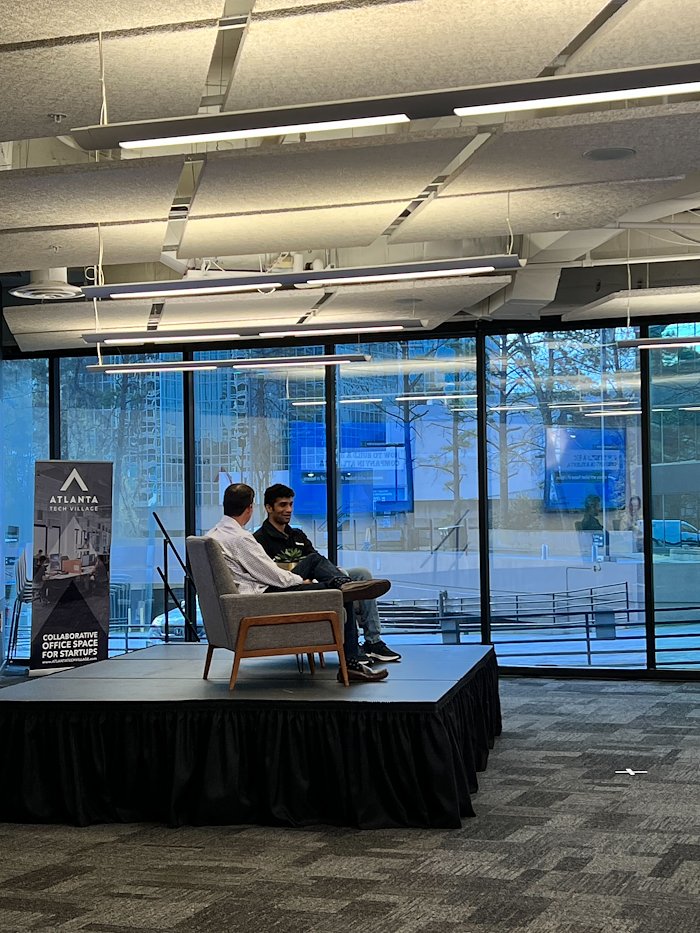
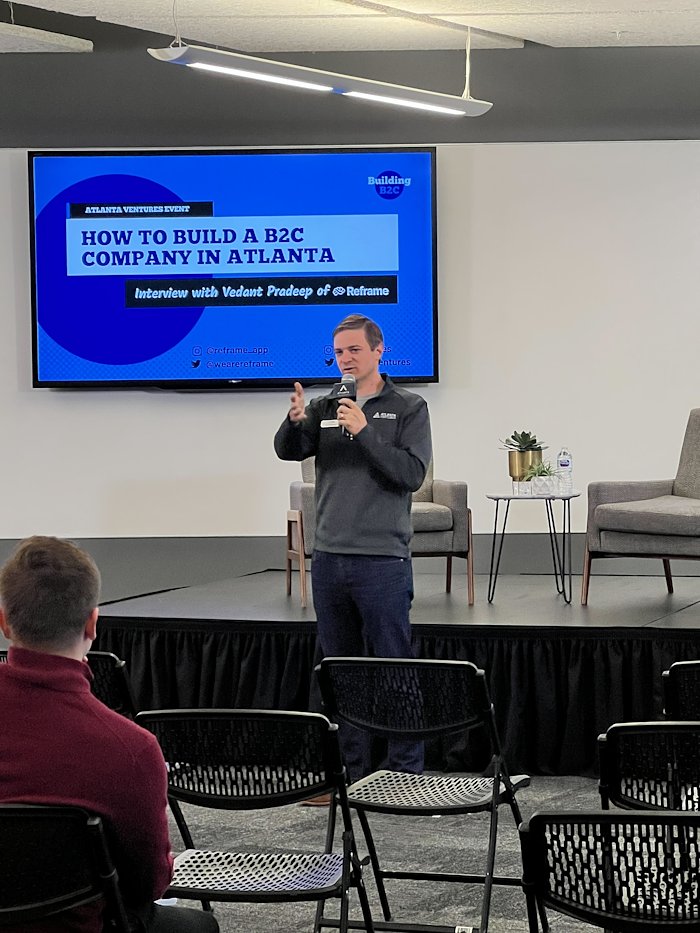
On Wednesday, March 29th, Atlanta Ventures Partner A.T. Gimbel sat down with Reframe Co-Founder and CEO Vedant Pradeep for an in-depth interview on how he and Co-Founder Ziyi Gao grew Reframe from $0 to over $10 million ARR in a single year. Following the conversation, members of the audience were able to ask questions during a live Q&A session.
Reframe is an Atlanta-based B2C app that helps people build healthier drinking habits, using neuroscience to help users reframe their relationship with alcohol. A.T. wasted no time diving into Vedant’s journey — from his early days at Georgia Tech and Create X, to meeting Co-Founder Ziyi Gao, testing the earliest ideas, finding the first customers, and scaling Reframe into one of Atlanta’s fastest-growing consumer startups.

“88.63% of our users, at month two, have cut back their drinking by 50%.”— Vedant Pradeep, CEO and Co-Founder of Reframe
Five Key Takeaways
Failing is great
Vedant shared Reframe’s mindset of failing fast. Over the past few months, the team has shipped over 158 iterations of the app — of which 70% fail. “We are looking for the 30%,” Vedant said. “We are willing to fail with these updates and features so we can get the one third of ideas that do work.”
Move fast
Another theme behind Reframe’s rapid rise has been speed. “You don’t know what’s going to work,” Vedant said. When a new feature doesn’t land, the team notices quickly and pulls it. In the consumer space, feedback comes fast — which means iteration can too. “Don’t wait too long scheming ideas and waiting for perfection… just do it!”
Don’t make anything too complicated
Vedant stressed simplicity — both in the core idea and in onboarding. Ideas that are too complex for customers to grasp tend to get pushed back on. And if onboarding isn’t easy and intuitive, customers may leave intending to come back later, and never do.
Offboarding is just as important as onboarding
Counterintuitively, Vedant emphasized the importance of giving people a reason to come back, rather than exhausting the app in one sitting. “It’s like having too many cookies,” he said. “If you have them all at once, you’re never going to go eat them again.”
The product needs to make people feel good
Especially in consumer products, people need to feel good using — and sharing — what they’ve built. “If a product doesn’t make you look good, then no one will want to share it,” Vedant said.
“We built a lot of stuff that people really didn’t care about, and for the first time, people were sending us messages saying this has been helping them with their lives.”— Vedant Pradeep, CEO and Co-Founder of Reframe

STAY CONNECTED.