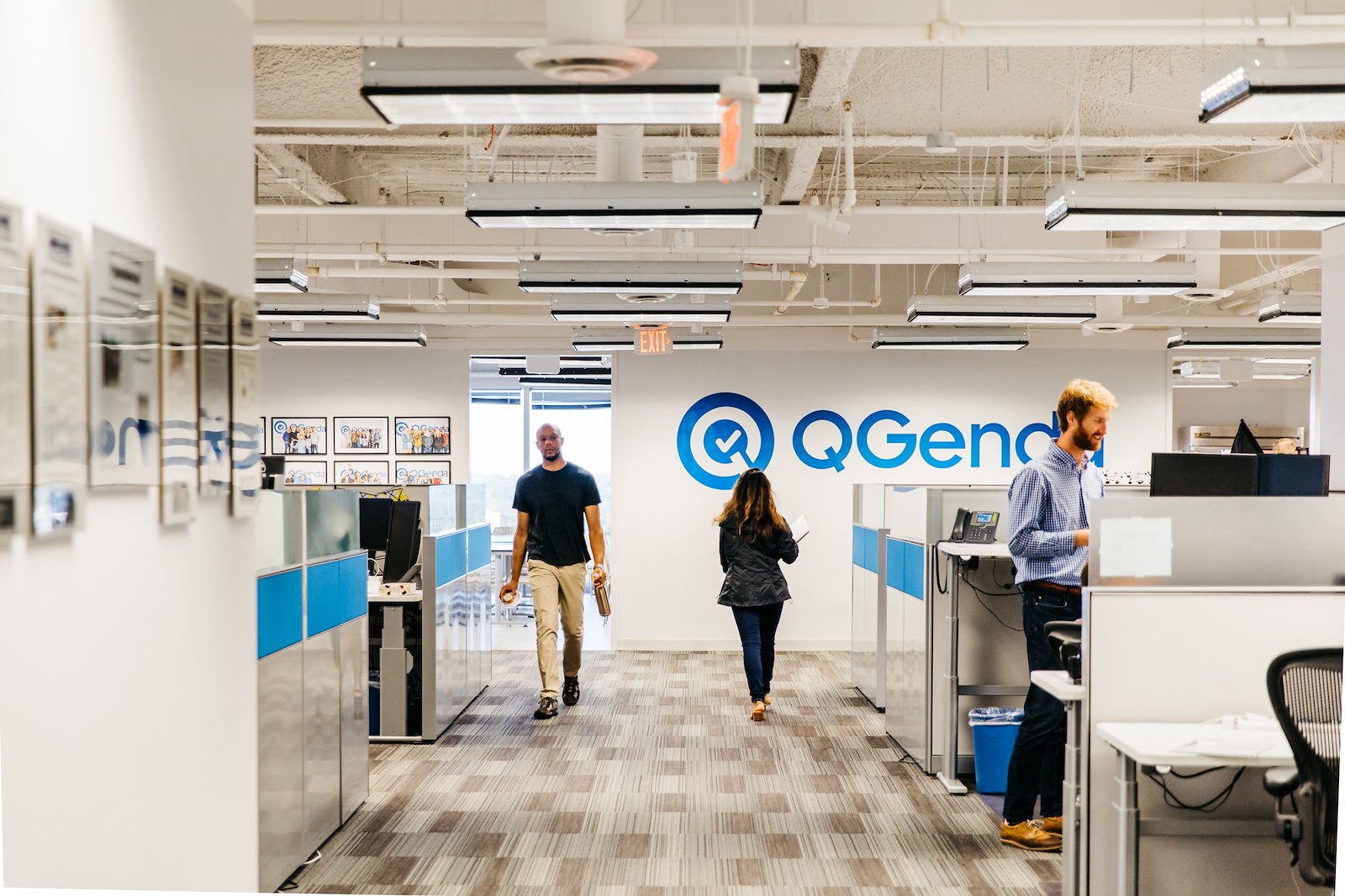
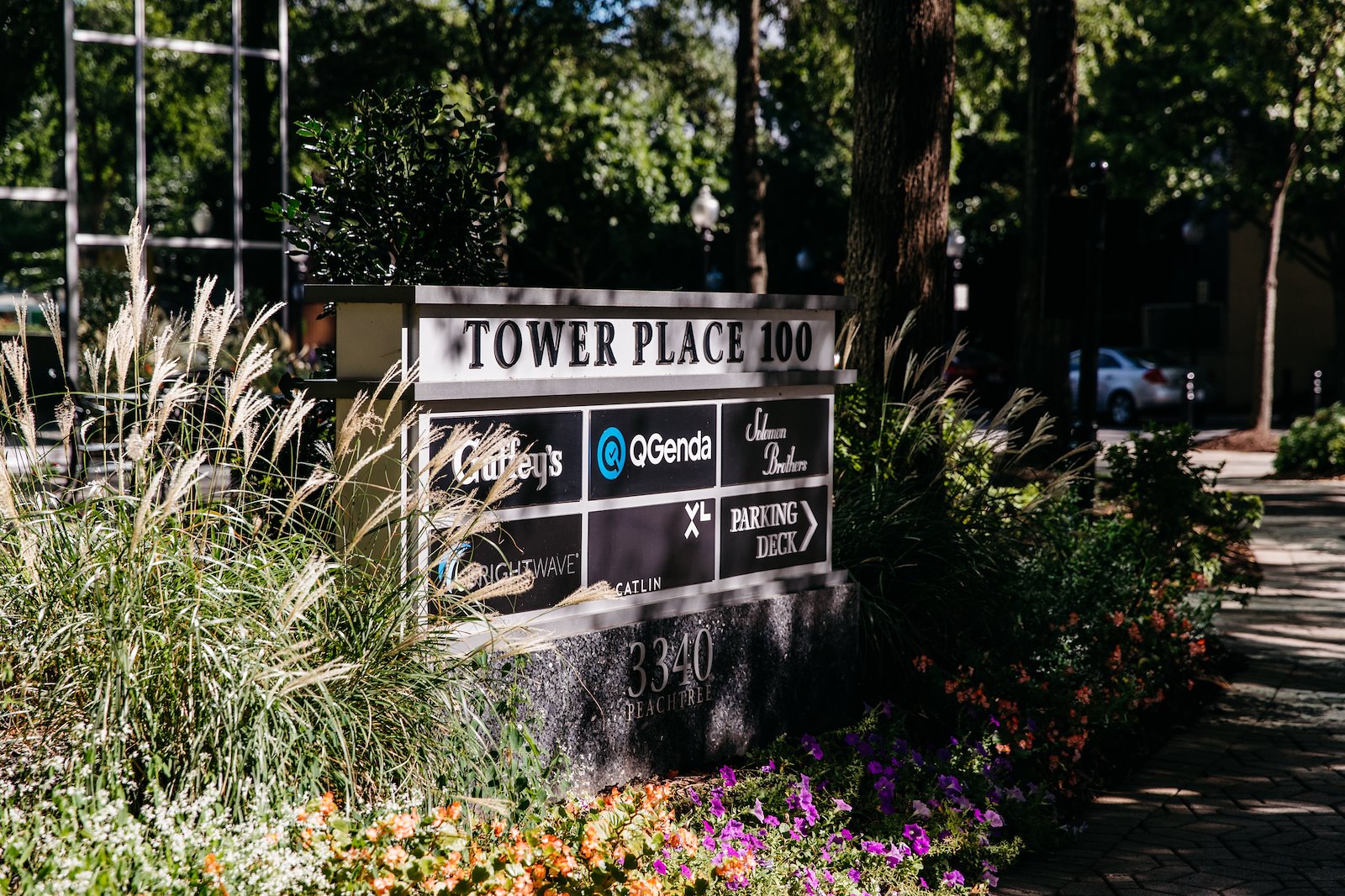
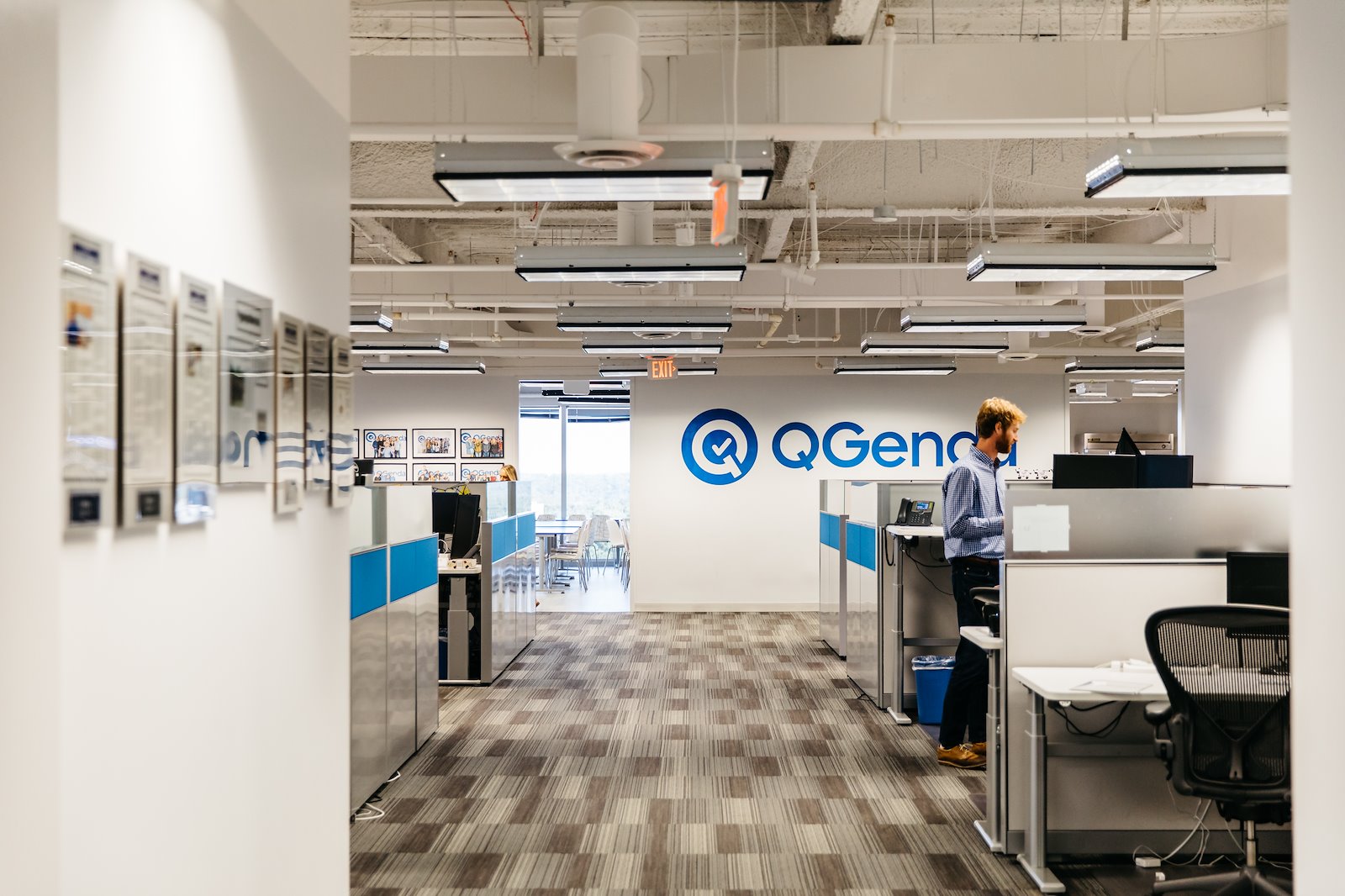
The elevator doors opened on the 11th floor of Tower Place 100 and a massive, backlit sign with the word “QGenda” beamed bright for any visitor to feel. As I meet QGenda Founder and CEO, Greg Benoit, we walk into a lengthy boardroom that looks out at the Buckhead skyline. Many of the buildings neighbor his recently purchased, 100,000 square foot building aptly named TechRise.
This setup sure does beat my parents’ basement.
Greg joked as we sat down to an hour-long scheduled interview, which turned into two.

Greg’s story is one about an entrepreneur who discovered a niche problem in the medical world at an early age. Through relentless curiosity, he solved a time consuming, annoying task doctors had when organizing call schedules. Years of “customer discovery” were spent before the startup term went mainstream. He turned this manual service into a product with the help of timely college courses and a knack for computer science — coupled with the dedication to wait tables and serve pizza for years while building it all. Today, those bright lights emanating from the QGenda sign proudly display a company valued in the hundreds of millions of dollars and consistently on the list for Fastest Growing in Atlanta.
All of this done without raising any outside capital until recently receiving a growth equity investment by private equity firm, Francisco Partners.
This story goes into how QGenda started, where Greg Benoit made life changing decisions, and how he is on the path to building a billion dollar healthcare company, while also adding to Atlanta’s tech-focused real estate portfolio.

Jon Birdsong: QGenda’s origin dates back to high school, was there anything before? I guess better put, were you a born an entrepreneur?
Greg Benoit: Yeah, so as a real little kid, the first business ever was a neighborhood recycling business. Going around to different neighbors and trying to get them to give us their cans, their newspapers, whatever—basically their trash. The grand vision was that we could take this trash and turn it into money.
Laughs from Greg
We didn’t know exactly what we were going to do with it. Were we actually going to recycle it or were we going to try and build airplanes out of it and sell that?
JB: This was elementary school?
GB: Yeah, really young! That business, I actually sold to my mom for, I think, a hundred dollars because the promise was that we wouldn’t keeping bring neighbor’s trash into the garage if she bought the business from my neighbor and me.
Laughs from both
One other thing before high school: I used to go down to Jacksonville and visit my grandmother, Nana. I used to spend the summers with her there—a month or so. This was from the age of 6 to my early teens. Well, Nana owned 6 beauty shops.
Some days she had me in day camps, but I would much rather go with her to the shops and help out. She would let me count the money. I remember how I would stand in the waiting area and greet the ladies and I’d help them with their bags, or bring them magazines, or get them water. Then one day, one of the ladies left a five dollar bill on her seat and I was like, ‘This is incredible’. So I went and took it to her and said, ‘Ma’am, did you drop this?’ And she was like ‘No, that is for you and that’s between us.’ Other ladies started doing this and Nana couldn’t figure out why I so badly wanted to come to the beauty shops with her. Nana had a big impact on me.

When we spoke, it wasn’t ‘if’ I own my own business one day, but ‘when’ you own your own business, you need to make sure you know how to do this.
I mean, I was seven years old the first time I saw someone get fired—and this employee worked for her for a long time, but was stealing from her. She actually brought me into the back and was like, ‘I want you to sit here, and you’re going to learn a lesson someday that you’ll use in your own business.’ Nana brought the employee into the back office and told her how loyal she was but she caught her stealing… and here I am, seven years old at the time.
Visiting my grandmother was very formative for me. She was in her sixties acting like she was in her thirties, managing 60 people, negotiating with equipment vendors, and constantly getting asked to expand the success of her shops.
Overall, she was a person before her time. That experience was really my first exposure of what it was to be in the day of an entrepreneur. From changing a light bulb, to greeting a customer, to letting an employee go, to negotiating new vendors like the big domes for hair, to repairing a sign. She did it all.
JB: Let’s fast forward to high school. Tell me about your early years:
GB: Pretty regular kid. I played sports, would ride bikes in the neighborhood all day, some Nintendo video games, and liked computers.
JB: Were you a good student?
GB: Yeah pretty good. Math, I always excelled at and that’s applied well at QGenda today. It’s really a mathematical puzzle when you think about scheduling.
JB: Alright, so let’s talk about this infamous dinner that started QGenda. Was it really a dinner?
Laughs
GB: The story keeps getting bigger, but yes, it all started with a simple dinner. An old time family friend who was an anesthesiologist at St. Joe’s hospital in Atlanta was over for dinner and was really just venting and complaining about how it was his turn to create the call schedule. He had this light bulb moment at dinner and said, “Greg, why don’t you do it for me.” Then he was like, “It’ll be a great summer project and I’ll teach you all the intricacies and the rules and I’ll pay you a thousand dollars.” All I heard was a thousand dollars!” Here I am a 15 year old kid!
From there, we went over to his house and he lived in a beautiful home, beautiful family, nice kids, nice cars, and that’s when I actually thought I wanted to be a doctor.
JB: And he did not want to put the call schedule together?
GB: Absolute zero interest. It was too time consuming and too painful. He wanted to practice medicine which is what he loved.
JB: At this list time are you thinking software can solve this problem?
GB: Not even thinking software. Just thinking excel spreadsheet and maybe I’ll write a few formulas and get fancy if I have time—but not thinking software. Not thinking company, just thinking, how do I get this done in a way that I can do it quickly and get paid and make a thousand dollars.
JB: So how many doctors did he have?
Twenty, and you have to schedule their practice for the entire year, including their vacations. That was a constraint because only certain people were able to take certain calls. Then they gave me all the rules like, these two doctors used to date in residency and now they hate each other, so they can’t be on call. These two are married and have little kids at home so they both can’t be on call at the same time for child care purposes. Then some take 2 weekends of call others take 6 weekends of call. Every input was another puzzle I had to solve and I loved it. I underestimated the complexity.
JB: So he gave you all the inputs?
GB: I went over to his house and we gathered around his dining room table and he pulled out this binder. It was leather bound and massive. The binder had all their rules, mostly hand-written, some of them typed on a typewriter. The pages were so old a lot of them had wine stains and coffee stains. This was the binder that was handed down every three years to the next scheduler. So it was my family neighbor’s turn to do the schedule for the next three years. He was Partner in the group.
JB: Was there any grand vision about where this could go?
GB: I was solely focused on solving this one problem. I was very focused on making sure he was a happy customer as well as learn all I can about this. So I took their binder and the funny part was he didn’t even want me to leave with it because it was so sacred to the group. It was the only place that had all the rules related to scheduling to their group—which was specific to just that one group at that one hospital.
I ended up taking that home and started going through it.
JB: Did he give you a time frame?
GB: The summer. I had until Labor Day. I started to solve the problem on paper and then switched over to Excel, then I went back to paper, then I went back to Excel. I was just trying to figure out what is the best way to do this and solve this problem. I finally ended up doing it in Excel.
JB: How iterative was the process?
GB: I did twenty to thirty renditions of a schedule. Every time, I’d go over to his house, show him and he’d say, “You broke this rule, you forgot about this, oh, this can’t happen, oh this person got way too many weekends, that’s not fair.” I kept getting better and better and finally I had a schedule for him by the end of the summer that was perfect. He then sent that out to the rest of the group and they were ecstatic.
JB: How did he send it out—email?
GB: I compiled it in a calendar format where he could print it out and give it to everyone, and that was it for that year. Then the radiology group out of Northside, right across the street, called out of the blue and said “Hey, I heard you’re the kid who does schedules on the cheap.”
So next summer, I now had the anesthesia group and the radiology group. I built both of their schedules and got a kid from the neighborhood to help and made a little more money the next summer doing it…and that’s probably when it started to settle in that there could be software to do this automatically. Over that school year, I started taking concepts from high school and applying it to what I was doing over the summer.
JB: Were you able to work on this during the school year?
GB: Not really. With school work and all the other activities, I couldn’t put much time into it during the school year.
By the time senior year came around, I had 8 groups I was doing it for and they each paid me $2500 a year to do it. By the time I went to college, I thought I wanted to become a doctor. I spent so much time around them and thought this would be a great life. They had great families, they got 10 or 12 weeks off a year—which I knew from doing their scheduling (laughs)—they worked hard, and really cared about helping people. So all of that sounded great.
JB: So you went off to Miami of Ohio with 8 customers, paying your way through college?
GB: That’s right. I went off to college, Miami of Ohio. I looked at Georgia Tech, UGA, UF, which was closer to extended family and my parents went there, but Miami was the right decision. 15,000 students in their undergrad and great Comp Sci program. Even though I wanted to do pre-med, I was thinking of majoring or minoring in computer science as well. You know, be a doctor with a technical background.
JB: Random question to that point. What do you think about doctors today who have a computer science background and want to build a software company?
GB: It’s tough. I know a fair amount of doctors who are in the business world, some of our competitors are doctors that have created a scheduling program.
JB: Why is it tough?
GB: It’s tough because almost all of them can’t give up the physician lifestyle to truly be a startup entrepreneur.
A startup entrepreneur is not someone who makes several hundred thousand dollars a year being a doctor. Your business will always come second while your medical profession comes first and that is why it’s hard for me to invest in doctors who want to start their own businesses.
How can you go from being paid so well to reverting back to making negative five hundred thousand dollars a year with the exact same lifestyle. It’s really tough and I have not seen it done successfully yet.
JB: Okay, let’s jump back to Miami of Ohio.
GB: Yes. So I’m at Miami of Ohio going to be this doctor with a leg up in computer science and who knows what that would lead to. These Comp Sci projects and homework that I’m doing is really starting to come naturally to me. Other kids on our floor in our dorm who were taking these classes would take 4 hours to do an assignment where I could do them in 30 minutes. So I think, “Man, maybe I really have a knack for this.” And then when I was working on chemistry and biology, and some of the other pre-med courses where some of the kids on the floor were doing those assignment in 30 minutes, it was taking me four hours. I began thinking maybe this is too much and I should focus on the area where I clearly have an understanding of the subject matter.
So, switching up was pretty easy. I stopped signing up for pre-med courses and just doubled down on the Comp Sci degree.
And all of this was sophomore year. I just couldn’t take 8 hours in the library, beating my head against the wall trying to do a chemistry assignment, especially when I would much rather be working on a Comp Sci assignment.
JB: In between freshman and sophomore year did you keep those customers from high school?
GB: I kept them all.
JB: So that was good college money?
GB: It was, it was great. I was making thirty thousand while in college. It helped my parents out and still had some student loans so that money helped tremendously. It was a good situation because I wanted to keep the existing doctors on and they still wanted to keep me as their professional service scheduler. They relied on me and I had some loyalty to them so I’d take phone calls all the time to make sure all the schedules were working like they should be.
For example, the first time I ever went on Spring Break was my senior year. Spring Break was normally a great time for me to focus for the whole week on schedules.
JB: Did you do internships during the summers?
GB: Nope, only this. Overall it was a great thing to do to get through college and pay for tuition and have a little bit of spending money.
JB: So did you move back to Atlanta right after college?
GB: I did. I moved back May of 2006. I knew Thanksgiving of 2004 (fall of Junior year), I was going to move back to Atlanta after graduation and start QGenda as we know it today. Back then, I was contemplating working at a big company like Microsoft, but after talking with family, friends, and mentors, I set my mind to starting QGenda and building a web application around what I had been doing manually for almost 8 years now.
JB: Did that confidence in turning your professional services work into software come from college?
GB: Yes. During my freshman year, I became friends with a senior who had built a SaaS application and successfully signed the Red Cross as a major customer, which was pretty cool.
That was the first time I understood, we are being provided the knowledge, the tools, and wherewithal that we could use to build something and sell it … and that was incredible.
In May 2006, QGenda as we know it started. The focus was 100% on his existing eight customers who were paying him for his manual work. The goal was going from having eight customers to a hundred and eight customers. When he started building the application, he looked at each feature through the eyes of scale by continually asking himself, “How can I get over a hundred customers with the help of this feature?”
JB: Now let’s put on your investor hat. With companies and entrepreneurs that you look at today, are you pattern matching their journey to your successful journey by seeing if they are looking to automate and scale something they are doing manually today?
GB: Yes. Definitely. Doing manual, laborious processes that have a high yield is a great way to find a potential business. There is a reason they keep doing the manual process and that is because there is value and worth in that individual taking the time to do it. So then the question to ask is, “How can we put software behind what that person is doing to make it faster and more efficient?”
JB: Absolutely. So let’s go back to those 10 passionate paying customers and the journey to them. When you moved back to Atlanta, how did you start?
GB: I was living in my parents’ basement and my typical day was basically this: wake up at 8:00 a.m., program all day until 4:00 p.m., and then go wait tables and bartend at Ippolito’s in Sandy Springs. I’d make 50-60 bucks a night and weekends a bit more, but that was it. That was my life 7 days a week, same thing everyday. I’d program all day and V1 took a year and a half.
JB: Did you think about bringing someone on as a co-founder?
GB: I did. Looking back, this was the hardest year and half of my life. I think about how I could have done it differently. I should have had someone help me. Whether I would have hired them, whether they would have been a co-founder, or something, I could have made that work. I had the means to do it and I just didn’t. It was a very painful and lonely process. Lots of ups and downs. For example, I spent three days thinking about a problem where I likely could have spent three hours with someone else there rapidly bouncing ideas off each other.
JB: Are you telling readers who want to start a company they should find a co-founder?
GB: Absolutely. I’ll only invest in companies with co-founders, that’s how much I believe that statement.
JB: Is that more of an efficiency reason or a health and psychological?
GB: That is more of a health and psychological play. I think it’s important you have someone who is just as excited about building this as you are. So that’s a psychological aspect, but I also think it’s going to make you succeed faster because your network, presence, momentum, and more is immediately doubled.
JB: Let’s dive into the QGenda product and go back to those 10 paying customers. Describe to the readers what QGenda’s software does:
GB: Let me describe this in the journey of an entrepreneur’s product, which is of course the MVP. The breakdown of QGenda’s MVP was four things: it was an algorithm that would automatically build schedules, it was a user interface that would let a scheduler edit and manipulate the schedule, it was minimal reporting, and the last one was just being able to view schedules (so everyone else in the group could log in and view schedules). That was it, those four things. Now those are four massive things. For example, the algorithm had to work for 10 different types of specialties, but if it worked for those 10, I knew it would work for just about any program in the country.
JB: How did you know that these features were enough to sell at the starting price point?
GB: These were the four features that I took to my existing eight customers and all of them needed these and almost as importantly, they were saying if we had those four features they could go and get us signed up in others departments in their hospital. It was through constant communication with them.
JB: How often were you talking to them?
GB: Every day. I’d call, text, email, and go meet them at their house or Starbucks, wherever was convenient for them. I remember the time I knew this was real—one of the first doctors I was working with actually logged in and spent 4 hours updating the variables for their schedule. It ended up getting erased and of course I didn’t have a backup at the time, which lead to one of the hardest phone calls I had to make, but the update I made to the product made the entry of variables for the schedule that much easier. When that moment happened, I knew what I was building was real.
He was so mad, fortunately we are able to joke about to this day. I remember he was under the gun to the get the schedule done and taking his first leap where he actually built the schedule with the software and not me.
JB: How long would it have taken if you’d hired a rockstar engineer?
GB: A year. I’d say 6 months but it would take twice as long, so a year. But that year and half wasn’t in a vacuum, because I was still providing professional services to my existing customers.
JB: So is it safe to say QGenda spawned from a professional services model?
GB: Yes, absolutely. I believe a lot of great businesses do that. There is just no way we could have 3000 customers like we do today, without software. Those 8-10 early customers on the services side was our Product/Market Fit. If we could make them happy, I knew we could build a substantial business.
JB: Before we get into the growth years, let’s go back to that long and lonely year and a half. You know the feeling you get as an entrepreneur: one night you can’t go to sleep because you’re so excited about the reality of building a billion dollar business, while other nights you’re questioning everything you’re doing. Did you have those ups and downs?
GB: All the time. I remember thinking, maybe I should build websites for people. Because back then, it was really good money and everyone needed one. People were willing to pay $10K for a website.
JB: When I walked into the QGenda office today, I saw a sign that said: the moment you feel like quitting is when you know you’re on the brink of success. Were there moments when you felt like quitting?
GB: Oh yeah. I remember having a deep heart-to-heart at Chili’s with my dad thinking “hey, I don’t think I can do this anymore, I literally feel like this is killing me.” It was a lack of momentum, a lack of progress on some of the problems I was trying to solve, and in the back of my mind, the opportunity cost was always there. For example, I could be making $75K a year with a much better lifestyle working for a larger software company.
JB: How did you get out of that funk?
GB: The way I think about getting out of those moments is knowing something has to break in your favor. If you work hard enough and put in the time, something will eventually fall your way. I remember vividly trying to solve one of the more complex problems around the algorithm and just being stuck. Then, out of the blue, I got an email from one of my old college professors who sent me a link to an article about the 9 Queens Problem. It was actually chess related, asking how do I put nine queens on the board without them interfering with each other. That solution gave me an idea around solving a scheduling problem, and I remember all of that happening within the span of a few hours. Regardless, whenever you are at that point in your journey, you’ve got to get a win, no matter how small.
JB: And that was 6-9 months in the journey?
GB: Sometime in ‘07, so yeah, exactly right around there.
JB: How did you know this was going to be something more than software a few doctors liked?
GB: Really, it was going to a trade show in ‘08.
JB: How long did it take to build the MVP?
GB: That doctor logged into the product in January 08′ and I started working on it in May of 06, so a year and half-ish of working on it until it was ready for the first user.
JB: Right now, tons of entrepreneurs are trying to figure out how to acquire customers. Why did you go with the trade show route?
GB: Every one of our early customers said they go to a specific trade show in the fall each year. It was that simple. I listened to them. We got 80-100 leads from that first trade show. My mind was blown. Of those 80 leads, 40 of them became customers within the next 6-9 months.
JB: Did you think about raising money at all?
Nope, didn’t even know what raising money was. I didn’t know that was a thing.
I didn’t go to any community events, didn’t even know they existed. I was just trying to build a business. I didn’t know there were these amazing organizations and community events, I wish I had. And today, fast forward 10 years, it’s a lot easier to find value-add events like those.
JB: Let’s go back to those 40 leads that became customers, what was your onboarding process like?
GB: It took some trial and error but the doctors were skeptical. They said there was no way our software could schedule for their specific program. I told them, “Okay, I don’t like to buy things unless I try it out first so, why don’t we onboard you and then you’ll have 90 days to cancel.” We charged for the onboarding and then all of them ended up paying for the product after 90 days. We didn’t have our first churned customer until late 2012!
JB: How did you onboard all of these customers when it was just you?
GB: We hired our first employee who is still an employee today, Lori. She did everything from sales, marketing, support, and has gradually shifted into Operations as the company has grown. She was employee #1.
This all leads me to say that at the end of ‘08 we had around 100 paying customers and were around $400K in ARR.
In ‘09 we hit our $1 Million ARR target and the whole time were extremely profitable. The concept of spending more than we brought for the sake of growth did not occur to me at that time, I was just trying to build a good ol’ fashioned business but with software as the product. We’ve never burned money, not once—but it’s something I would do different. I was building a parlor type business but the difference was customers kept paying each month or year and the software was doing the work.
JB: It seems so simple. What were some of the key takeaways getting to $1 Million ARR?
GB: The pricing model worked. We could bring on sales reps and they got paid and it was worth it to them and the company. Churn was just about non-existent. There were one or two onboardings that we learned from. We didn’t do any outbound except 5-6 trade shows a year. We just met the customer where they were.
JB: Now bring us to today, because there are a few other items I want to make sure we cover, including Francisco Partners’ investment and TechRise.
GB: Sure. We kept building in 2011, and then 2012 Venture Atlanta was a big deal for us. I think Bird Blitch called me out of the blue and said, “Hey, Venture Atlanta would really love to have you participate.” We weren’t fundraising, no one had ever heard of us. We had a couple million in revenue as well as a couple million in the bank. I ended up doing it to network and meet some folks. I did it and it was a phenomenal experience. I ended up meeting David Cummings at a dinner that week, who just a few weeks earlier had sold Pardot.
After Venture Atlanta, we hired 4 BDRs and 2 Account Executives, including Frank Tumminia. Beforehand, we were all inbound.
JB: And then y’all were off to the races?
GB: Yes, we were off to the races! At the end of 2013 we were around 20 employees and today we’re over 200. Francisco Partners came in around June of 2016. In revenue terms, we went from $5 Million ARR (2014), to $10 Million ARR (2015), to $20 Million ARR (2016).
JB: Why did you take chips off the table growing so fast?
GB: In 2014, we began getting very serious offers from strategic buyers. We received one formal offer. They gave us a term sheet, flew down here, met with us, and the offer wasn’t what we believed the business was worth. They ended up acquiring another company in 2015. This was a multi-billion dollar company and their game plan was to take the existing customers they had and spread that offering to them. That event caused me to really think about what we needed to do for QGenda to compete, because if they started executing on that plan, we needed to be ready and we needed to be sophisticated enough to ensure QGenda would be around for the next decade. That was when we called our investment bankers to start the process in approaching a private equity group that was healthcare specific.
JB: Three years later, how did the acquisition of your competitor by the strategic buyer turn out?
GB: We don’t run into them at all.
JB: Interesting.
GB: Yeah, the way I look at raising money is this. We literally brute forced our way to $20 Million ARR. We didn’t really have a real CRM, we had little automation, we didn’t have any tools, we literally hustled our way there, which is incredible and speaks volumes to what Frank and the team did. But to go from $20 Million ARR to $100 Million ARR, you can’t brute force hustle your way into that. You still need to do hustle, but you have to be more strategic, thoughtful, and you have to know pattern recognition. These were all things we weren’t experts at. So it was all about getting with a group of investors who had done this before, with this type of company and so much of it is pattern recognition.
JB: Very insightful! So today, you’re still CEO of a very fast growing SaaS business, investor, and…building owner. What’s next? You’re still young, 35, right?
GB: 35, right. Everyone asks, “Why did you buy the building?” The idea for buying the building came back when we signed our lease at the Ravinia in ‘09. Here I was, a 25 year old kid signing a 4 your lease. We ran out of space in six months there with just the 10 people we had in the company. We ended up having people on different floors and different rooms and it affected our culture. We ended up getting through it, but it burned something in my mind around: ‘Why is this not easier for fast growing companies?” The idea was burned into my mind then, but I didn’t have the funds or the time or wherewithal to execute. After being fortunate enough to take some chips off the table with the private equity group, it resurfaced. I went through the pain and the QGendas of tomorrow—of which most are coming out of the ATV or ATDC (post 10-15 employees), I want to make sure those companies have a place to call home with flexible terms and space.
JB: Has the explosion of co-working space solved that problem? Better put, how is TechRise different from WeWork, Industrious, or Spaces?
GB: TechRise lets companies create their own identity. At all the other places, you’re part of their culture, even at Atlanta Tech Village—which, by the way, is crucial when you’re starting out, but at some point you have to break away. You have to start creating your own identity and defining what your own company’s culture is going to be, and that’s where we come in. We let you do it in the most flexible way in the entire Southeast.
JB: So entrepreneurs reading this who have 10 employees up to 150ish are a good fit?
GB: Exactly. A whole floor can have up to 150 people.
JB: Did you look at any other building besides the one you bought?
GB: We looked at three or four buildings in the Buckhead area. We knew we wanted the first one to be in Buckhead.
JB: Nice. Will the next one be in Atlanta or another city?
GB: Atlanta.
JB: When is the first tenant moving in?
GB: September, 2018
JB: Great. Let’s wrap by putting on your investor hat. You’re still CEO and just closed a massive deal with QGenda.
GB: Yep, largest one in company history.
JB: Very cool. You’re also a building owner and you’ve got a team making that a success, you’re also investing, and QGenda is growing fast. Where do you spend your time?
GB: 90 percent of my time is on QGenda. We have something very special here and it has the potential to be very long-lasting for our customers, the Atlanta community, and our employees.
The other 10 percent is with TechRise and mentoring up-and-coming entrepreneurs.
I want to make a generational impact and I believe that is best done through entrepreneurship.
At the age of 35, with a scaling, multimillion dollar business and a new building ready to house the QGendas of tomorrow, Greg is ready to make a generational impact on the community.
He’s starting first with his own family.
As we wrap up, he shares, “Today, when raising my two little girls, I talk to them the same way my Nana used to talk to me: ‘When you start your own business…’
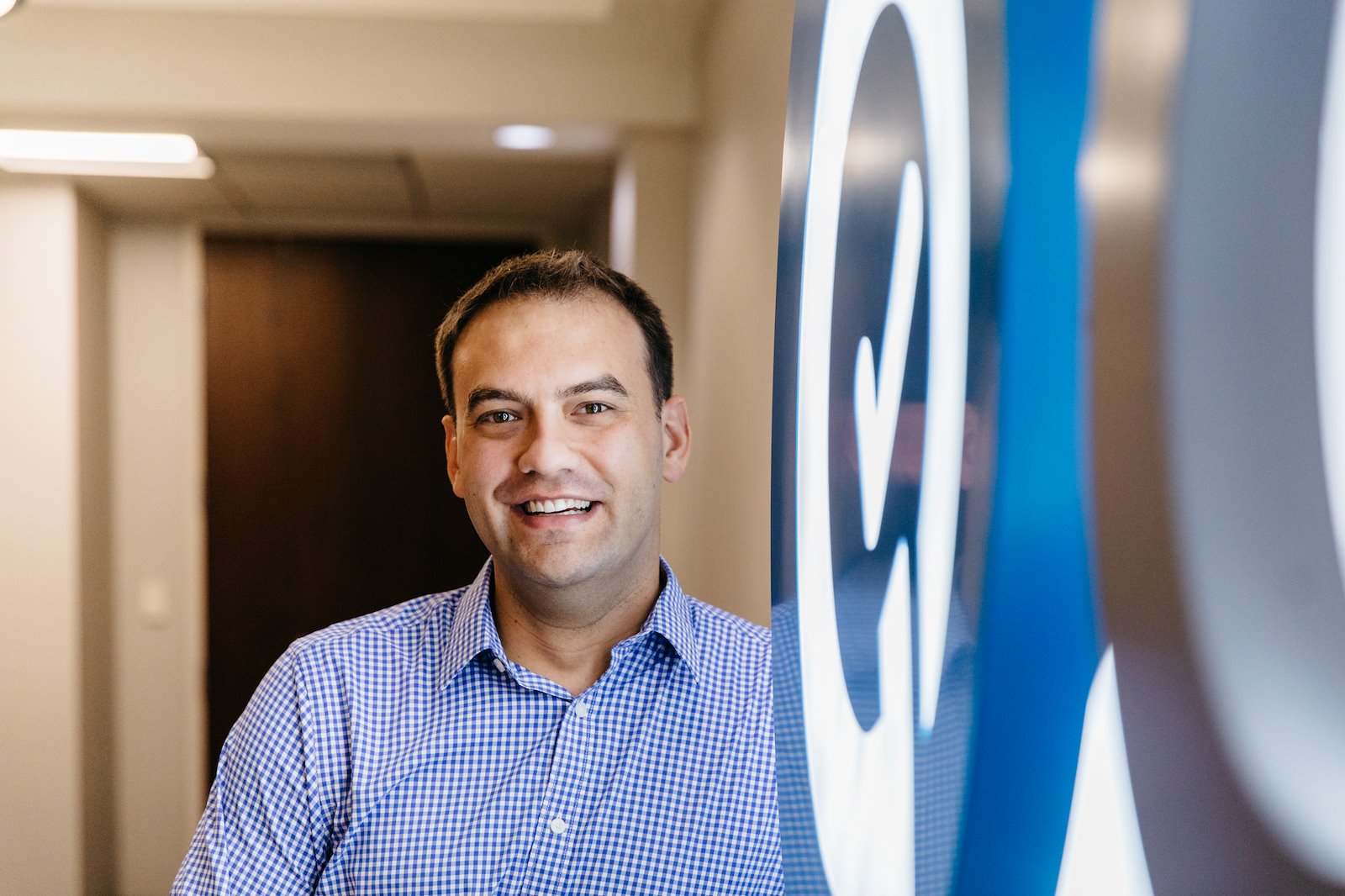
ENTREPRENEURSHIP RUNS IN HIS FAMILY’S BLOOD, AND THERE IS NO QUESTION GREG BENOIT WILL BE ON THE FOREFRONT OF ENSURING ATLANTA’S TECH RISE.
Story by Jon Birdsong